Category: Wildlife Photography

  • Sandhill Crane Migration, Nebraska

    Sandhill Crane Migration, Nebraska

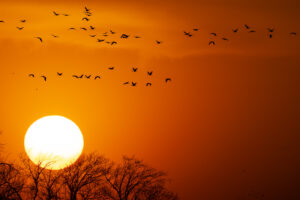
    It has been twenty years since I had been out to Nebraska to witness the sandhill crime migration so I thought I ‘d take a day and head northeast. Every spring, the sandhills descend on central Nebraska en masse so they can roost in the Platte River valley. There are upwards of 500,000 cranes in the area so it is a spectacle not to be missed.

    This year the weather cooperated. Unlike past years when the weather in late March can be unpredictable, this year it was sunny and around 70. Perfect. The sunrise and sunsets were spectacular as well, providing the perfect backdrop for groups of cranes flying in to roost in the river for the night or take off for the fields in the morning.

    The biggest collection of cranes can be found between Kearney (Exit 272) and Grand Island (Exit 320). During the day, the birds can be seen in the local farm fields fattening up on left over corn kernels from the previous year’s harvest. They will also take flight and move from field to field. Just before sunrise or just after sunset is when the real show begins, however. The birds fly in waves back to the river or take off from the river. The sun rises or sets in a big orange ball over the river. It looks like something out of an African safari.

    This year I went to the Plautz viewing deck near Gibbon to watch sunset while I stopped at the river bridge just east of Kearney (exit 279) for sunrise. Other options include guided tours from the Rowe Sanctuary (located between Kearney and Gibbon) or Fort Kearney State Park. The latter has a bicycle bridge over the river that provides good access. This one gets crowded so I prefer the other locations.

  • Florida Wildlife

    Florida Wildlife

    My family and I spent a week in southern Florida over the holidays and while we were there, we took in some of the wildlife refuges and the Everglades. Regrettably, the weather was not exactly picture postcard worthy, but I still enjoyed the trip. Florida is always a good spot for bird photography.

    Tropical Botanical Garden

    One of the first places we went was the Tropical Botanical Garden just south of Miami. Featuring several hundred acres of native plants it provides a spectacular backdrop for bird photography. The garden also houses a butterfly pavilion so it was cool to see that as well. The highlight was a crocodile sunning itself along the shores of the one the many lakes in the garden.

    Bill Baggs State Park

    Our next stop was Bill Baggs State Park on Key Biscayne. I had wanted to see the lighthouse but the grounds were closed due to renovation. I settled for shooting some birds along the fishing pier. I found a snowy egret and a great egret. I also spotted a small raccoon wandering the picnic shelter.

    Everglades National Park

    The following day we took a trip to the Everglades. I had never been so it was a chance to see something new. Most of the southern section of the park is made up of seagrass marsh. There was a constant smattering of birds but no mass collection of anything. We walked the Anhinga trail. I did get to see a great egret gulp down an anole, though. I also spotted a few manatees and a crocodile at the far end of the drive.

    Merritt Island National Wildlife Refuge

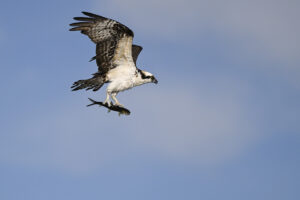
    The last place we stopped was the Merritt Island National Wildlife Refuge near Titusville, FL. This is a spectacular refuge that boasts a number of bird species. I spotted several kinds of herons, spoonbills, and many ospreys. I had fun watching the osprey snag fish. I just wish the light wa sa little better to highlight the birds.

  • Snowy Rocky Mountain Arsenal Wildlife Refuge

    Snowy Rocky Mountain Arsenal Wildlife Refuge

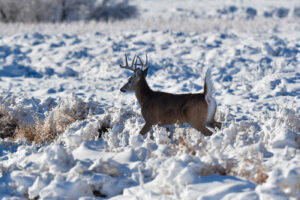
    The Rocky Mountain Arsenal National Wildlife Refuge in Denver is one of my favorite places to visit in winter. When it snows, it is a spectacular place. The white covers up the brown grass and makes for a an incredible winter scene. I saw a number of animals out today, particularly whitetail deer and bison. I even caught a glimpse of a bald eagle roosting in a tree far off in the distance. The only concerning aspect of the snow was driving long the wildlife loop where it had not been plowed. Fun times!

  • Bear River Bird Refuge

    After many years of wanting to visit this place, I finally made it out to the Bear River Bird Refuge near Brigham City, Utah. The refuge is located in the northern regions of the Great Slat Lake. Unfortunately, the bird migration that normally fills the skies in March occurred a couple of weeks early this year so I had to settle for the holdouts. Ten thousand swans were down to three. There were still a number of White pelicans, avocets, and various waterfowl still there, however.

    Another factor in the lower number of birds is the extremely low water levels in the Great Salt Lake. It has lost about 70% of its volume due to the drought hitting the western United States. You could see where water had been in previous years and all that was left was a dry field.

    The refuge itself features a scenic drive that you have to use to see most of the birds. The drive starts about 12 miles from the town of Brigham City, Utah. There are canals that line the road on either side. There are some birds in the canals but many more are in the marsh and the lake behind the canals. Inevitably, just when I found a large collection of birds, they would be in a portion of the refuge that would be behind a road closed sign. The refuge road gets you rather limited access to most of the birds here. I still saw a number of birds closeup, however.

    Even if there aren’t a lot of birds to see, the refuge is quite pretty. It is ringed by the Wasatch Front mountain range so the backdrop at either sunset or sunrise is pretty spectacular. So if you’re ever in the area, check out the refuge in early spring.

  • Pinckney National Wildlife Refuge

    Pinckney National Wildlife Refuge

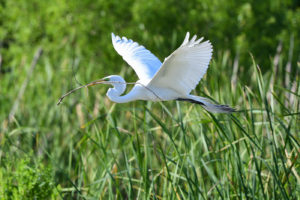
    A trip to Hilton Head island in South Carolina would not be complete without a trip to Pinckney Wildlife Refuge. It boasts a heron rookery full of Great Egrets, Blue Herons, and other wildlife. Ibis Pond is the setting of the rookery which is a pretty pond situated in a clearing. Afternoon is a good time to see the pond but morning would be good as well as the pond is situated in an east/west direction. Other ponds in the area include Osprey Pond and Nini Chapin. To get to Nini Chapin requires a 4 mile round trip walk from the parking lot. Leave yourself about 2-2.5 hours to see the ponds. More adventurous hikers or bicyclists can venture to Shell Point or Bull Point. All trails lead from the main parking lot which is just off Highway 278, the main road into Hilton Head.

  • Snow Geese Nee Noshe Reservoir

    Colorado is not generally known for having a large populations of migrating birds. Most are scattered throughout the state as birds head north or south during their migration. However, southeastern Colorado does have a significant population of snow geese that overwinter here when their breeding grounds in Canada and the Dakotas freeze over. I headed down to Nee Noshe Reservoir near Lamar, CO to check out this spectacle. I was not disappointed. We saw thousands of snow geese on the reservoir. Unfortunately, the large flock had settled out in the middle of the lake so no birds were close to shore. Even with my Nikon 500 PF lens, I could not get closeups of any particular bird. Instead, I waited for the birds to fly up in groups and I took pictures of the masses of birds.

    The coolest moment came when a bald eagle flew over the roosting birds, spooking them to fly up en masse. I have seen this phenomenon before but usually the eagle is far overhead. This time, she flew right over the birds. It looked like she was intentionally trying to set off the birds. Regardless of the bird’s intentions, it made for a noisy spectacle. Check my photos below to spot the eagle in the midst of the white birds.

  • Rocky Mountain Arsenal January 2022

    The Rocky Mountain Arsenal National Wildlife Refuge is a fantastic place to see wildlife and the fact it is close to the city limits of Denver makes it even more astounding. I saw bison, several red-tailed hawks, white tail and mule deer, and a couple of kestrels during my time there this morning. Some fresh snow made for some cool scenery as well.

  • Canada Geese, Stearns Lake 2020

    Canada Geese, Stearns Lake 2020

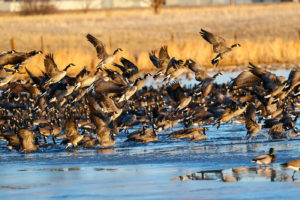
    One afternoon I found a couple thousand Canada geese on Stearns Lake in Lafayette, CO, so I decided to go back and photograph them the next morning. A brilliant sunrise and greeted me with purple and red colors when I arrived around 6:50 am. I photographed a few ducks flying through the clouds and then focused on the geese. After focusing on a large clump for about 10 minutes, the flock took off in unison into the lake. I wondered what had caused that reaction? My answer soon came flying over the lake–a bad eagle. I promptly snapped a dozen or so frames of the eagle which was an added bonus to an already gorgeous morning.

    I stayed for another half hour ro so taking in the scene and then watch wave after wave of geese take off. The Front Range mountains provided a beautiful backdrop. Thank goodness for the local farms and large estates preventing houses from coming right up to the lake so it certainly feels wild and remote, even though it is only 15 minutes from either Broomfield or Boulder. I will definitely go back to check out this very cool place.

  • Bosque del Apache

    Bosque del Apache NWF

    I spent a quick trip in New Mexico over winter break.  Bosque del Apache National Wildlife Refuge is a great place to visit in the winter since so many birds spend the cold months there.  I also explored some nearby refuges including the Bernardo refuge and Valle de Oro near Albuquerque.  All of these were good places for wildlife photography.  Bosque features sand hill cranes and thousands of waterfowl, including snow geese and several species of ducks.  I witnessed a beautiful mass take off of snow geese the morning I arrived.  I also saw several thousand pintail ducks.  I even spotted a javelina but it darted into the bushes as soon as I stopped.  I only had a 300 mm 2.8 lens with me on the trip so I focused mainly on photographing clumps of birds rather than individual birds.  Next time I’ll bring a 600mm lens with me.  

    Bernardo Wildlife Area

    The Bernardo wildlife area contains feeding grounds for sandhill cranes.  It is located just north of Bosque.  Take the exit for Highway 60 and head east.  Take the first left and then head north on the frontage road.  Shortly, the road brings you to the access to the Bernardo.  There were several hundred cranes clumped together in the fields.  There are a couple of elevate viewing decks to explore while you are there.

    Valle de Oro NWF

    Lastly, I stopped at a brand new wildlife refuge, Valle de Oro.  It is located about 5 miles south of the airport in Albuquerque.  The refuge is small.  It has a couple of roads through feeding fields and you can also walk a short trail along the Rio Grande.  I did;t see much while I was there  until four coyotes ran across the road.  They quickly disappeared but I managed to snap a couple of pictures before they ran off.   

Plugin from the creators ofBrindes Personalizados :: More at PlulzWordpress Plugins